
GarnishMe
From Shopify to Medusa.js, for local and international trade.
A Shopify-to-Medusa.js migration for GarnishMe, with a rebuilt Next.js storefront, regional catalogues and pricing, local and international payments, and continuity for existing content and URLs.
garnishme.store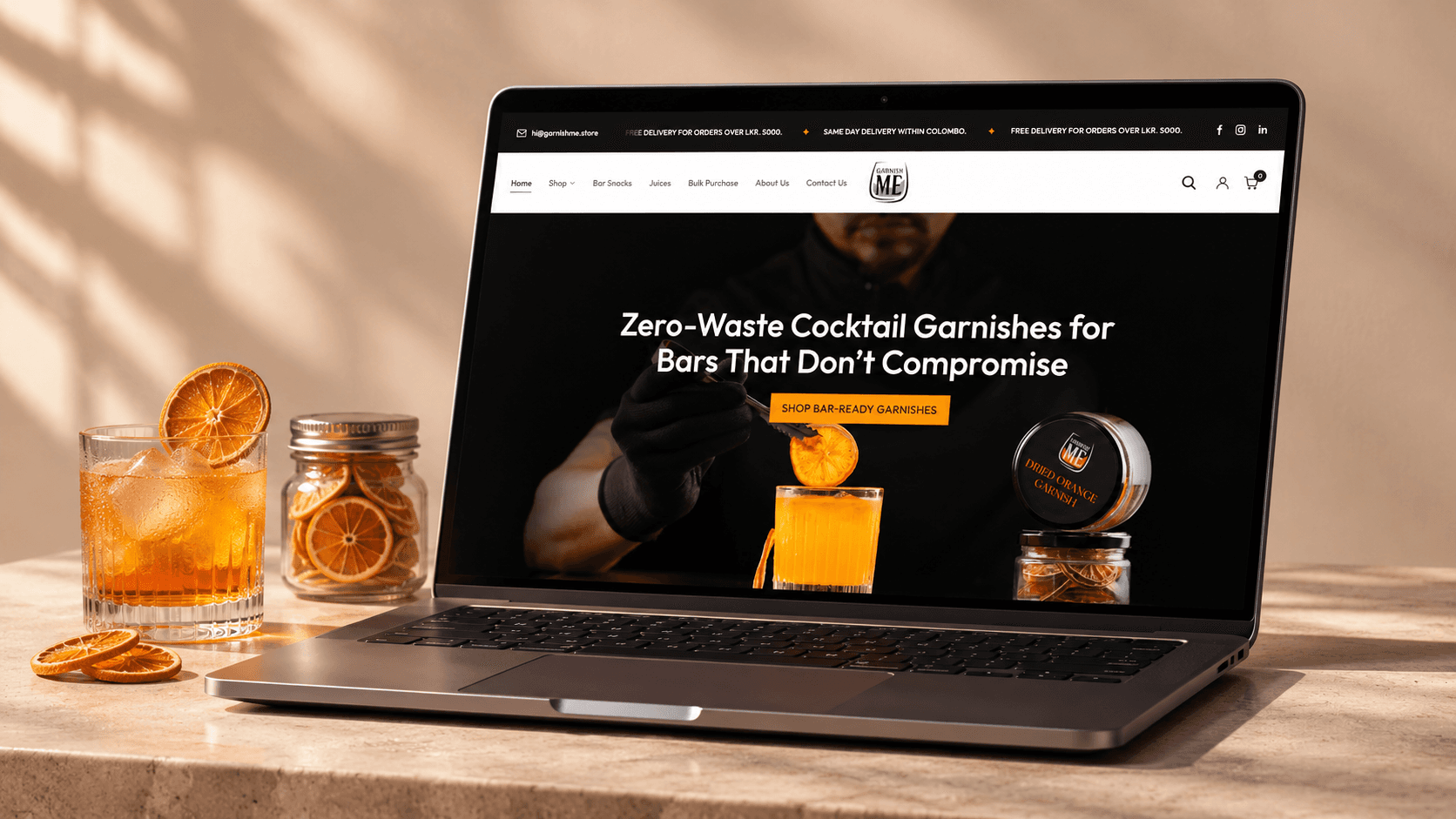
GarnishMe supplies dried cocktail garnishes to bars, restaurants, hotels and home cocktail makers, alongside juices and bar snacks for its Sri Lankan customers. We migrated its Shopify store to Medusa.js, rebuilding the storefront in Next.js and bringing the catalogue, content and regional selling rules into a system the business could run on its own infrastructure.
A familiar store on a new foundation
The existing brand already had a distinct look: dark cocktail photography, orange accents, generous product imagery and Outfit typography. We rebuilt that experience in Next.js, using the original storefront as a visual reference. The homepage keeps separate routes into bulk supplies and products for home use, while the navigation gives juices and bar snacks their own place.
The migration also gave us room to resolve small but frustrating journeys. The old country-selection pop-up told Sri Lankan visitors that the store did not ship to them. The new storefront routes visitors into the appropriate market, with regional pricing and delivery information carried through the shopping experience.

Two markets, with different products and sizes
Sri Lanka and international customers do not simply see the same catalogue converted into another currency. The store uses fixed LKR and USD prices, with product sizes and availability defined for each market. We consolidated duplicated Shopify products and mapped the regional variants into Medusa.
A product or size appears only when it has a price in the visitor’s region. That rule applies to product listings, size selectors and search results, so shoppers are not offered a variant they cannot buy. Meilisearch provides product search with the same regional filtering.

Checkout built around the destination
Sri Lankan customers can pay through OnePay or choose cash on delivery; international customers use PayPal. Delivery follows the same regional approach: Sri Lankan orders have a delivery charge with a free-delivery threshold, while international product prices include shipping. The cart and checkout explain those differences instead of leaving customers to discover them at the final step.
We also connected transactional email through Resend, including order confirmations and store order alerts, to support the day-to-day work after a purchase.
Bringing the content and links across
A migration reaches beyond product records. We brought across the store’s pages, blog articles and policies, along with product imagery and descriptions. Imported HTML is sanitised and internal links are rewritten for the new storefront. Existing Judge.me reviews were also brought into a custom review module, with approval controls for new submissions.
Shopify collection URLs redirect to the new category routes, and old product links point to their replacements where products were merged. Existing product handles and SEO titles were retained where applicable. These mappings give customers following older links a route into the rebuilt store.
Controls for the people running the store
We extended the Medusa admin with controls for announcement messages, homepage banners and featured product order. Wholesale enquiries are collected in the backend and can be exported as CSV for follow-up. Catalogue edits trigger storefront cache updates, keeping the public shop aligned with changes in the admin.
The store went live on the client’s VPS with the storefront, Medusa backend and search service deployed together. A separate staging environment supports ongoing changes. GarnishMe now has a custom commerce foundation for its local and international business, while retaining the brand and content customers already recognise.