
POS system for Kyla & Co.
An offline-capable desktop till connected to Medusa
A custom desktop POS for Kyla & Co's pop-up stores, with local product search, durable offline sale recording, Medusa order sync, returns and shift reconciliation.
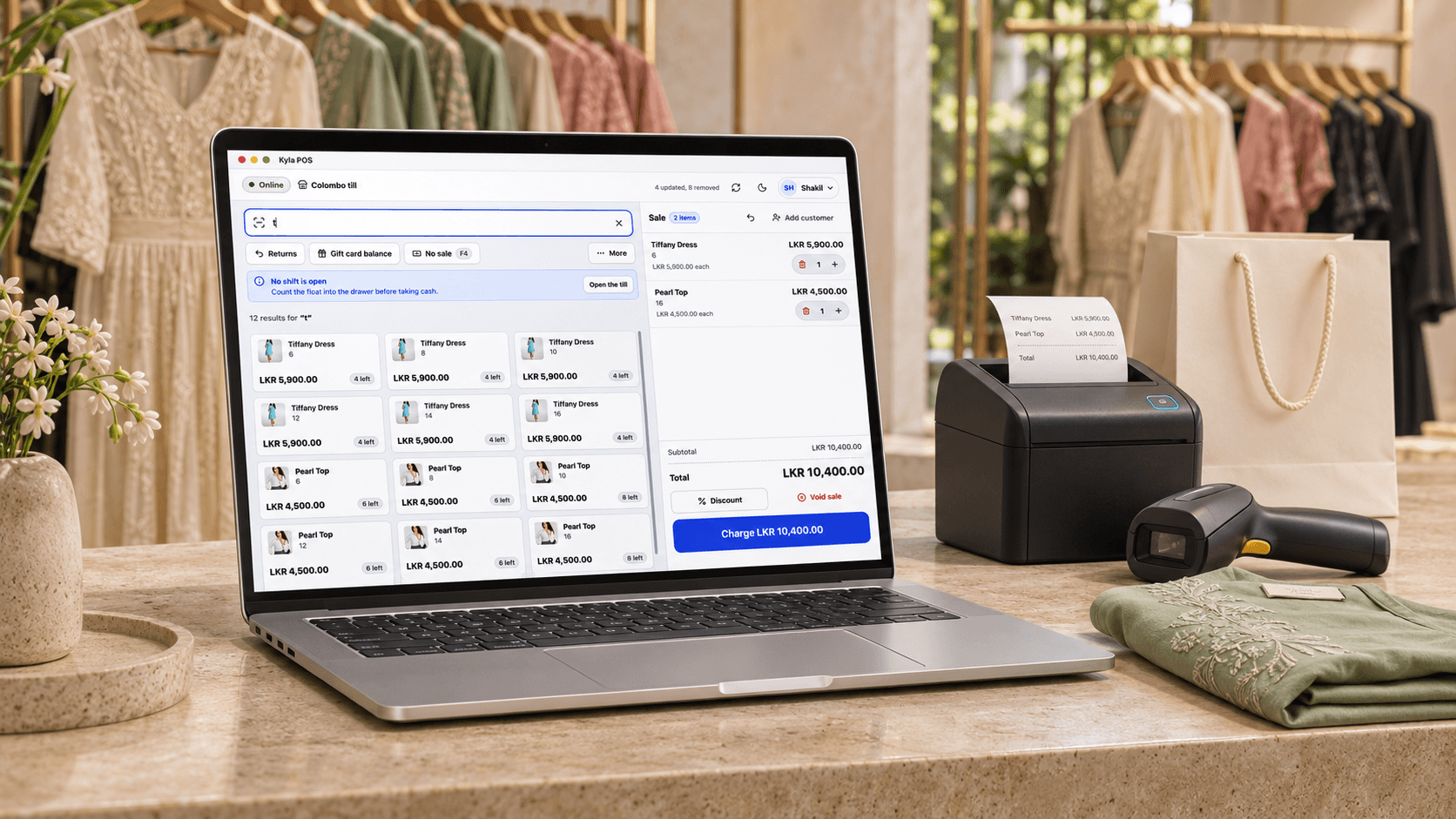
We developed Kyla POS for the pop-up stores of Kyla & Co, the fashion brand whose Medusa online store we also built. At a pop-up counter, a customer can pay and leave while the till has no connection to the server. The system still needs to preserve what was sold, what was paid and which cashier handled it.
We built Kyla POS as an Electron desktop till backed by a Medusa v2 plugin. Product search, checkout, returns and cash management share one workspace, while a local SQLite database keeps the catalogue and queued sales on the device.
Kyla POS in use at a pop-up store
The right size, price and stock at the counter
Clothing variants appear individually in search, with the product image, size, LKR price and available quantity. Staff can scan a barcode or search the catalogue, then adjust quantities and discounts in the sale panel beside it. The total stays visible on the charge action.
Search runs against the local catalogue. Displayed availability subtracts quantities in unsynced sales from the last downloaded stock figure, so the till accounts for what it has just sold even before Medusa receives it.

Recording the sale before relying on the connection
A cash sale is written to SQLite before the till reports it as recorded. The saved payload includes the prices, discounts, tenders, cashier and shift at the time of sale. Reconnecting sends those original details to Medusa; a later catalogue change does not rewrite the transaction.
The sync queue sends sales oldest first and retries temporary failures with increasing delays. After an interrupted upload, it asks the server whether the sale already completed. Conflicts and permanent failures remain visible for attention.
Three safeguards work together against duplicate orders: a stable sale ID generated on the till, a server receipt that checks the payload against that ID, and reuse of the same Medusa cart when completion is retried.
Using Medusa's commerce workflows
The plugin records sales through Medusa's cart and completion workflows. That connects counter sales to the existing inventory, payment and loyalty flows. Discounts are stored as line adjustments, and the original unit prices travel with the sale. The workflow also attempts counter fulfilment because the customer has already taken the goods.
Till calculations use integer minor units, with conversion at the Medusa boundary. This keeps discount allocation, change and cash rounding out of ordinary floating-point arithmetic.
Cash and payments already confirmed on an external card terminal, bank-transfer service or QR payment service can be recorded without a POS server connection. The app records those external payments; approval happens through the separate payment service.
Gift cards and store credit require a live connection to check and debit the balance. These tenders are available when the corresponding Medusa loyalty capabilities are installed.
Returns tied to the original purchase
Staff can find a purchase by order number or scan an item's barcode to look through recent orders containing that variant. A barcode identifies the product, so the cashier still selects the original sale. The order supplies the price paid, discounts and quantity still eligible for return.
Returns run online. Medusa calculates the refund, and the workflow receives stock into the register's location. Cash refunds are limited to the remaining cash paid on the original POS sale. With loyalty support installed, exchanges and guest refunds can use a credit note, while registered customers can receive store credit.

Closing the drawer with an explainable total
A shift opens with a counted float and records cash movements through the day. At close, the cashier enters a blind count before seeing the expected amount. The reconciliation separates cash sales, refunds, rounding and drawer movements; card payments and credit balances never inflate the cash expected in the drawer.
A sale that syncs after its shift has closed is still attached to that shift and marks the report as amended. The record can account for takings that arrive late after an outage.
A desktop app for counter hardware
Electron connects the React interface to local storage and printing through a typed bridge. Receipt printing supports network ESC/POS, raw print queues and operating-system drivers. A printing failure is reported separately from the recorded sale, so staff can reprint without treating the transaction as unpaid.
The printer needed its own integration work. For this project, we developed and open-sourced the Xprinter XP-365B macOS driver to make this label and receipt printer work smoothly with a Mac. On Apple Silicon running macOS 26 or later, it exposes separate AirPrint printers for labels and receipts, and holds jobs for the inactive printer mode until the mode is switched. The driver is available for other businesses using the same printer model.
The project includes packaging configurations for macOS and Windows. Kyla POS carries the client's branding, while the Medusa plugin keeps registers, locations and optional loyalty features configurable for other Medusa v2 stores.